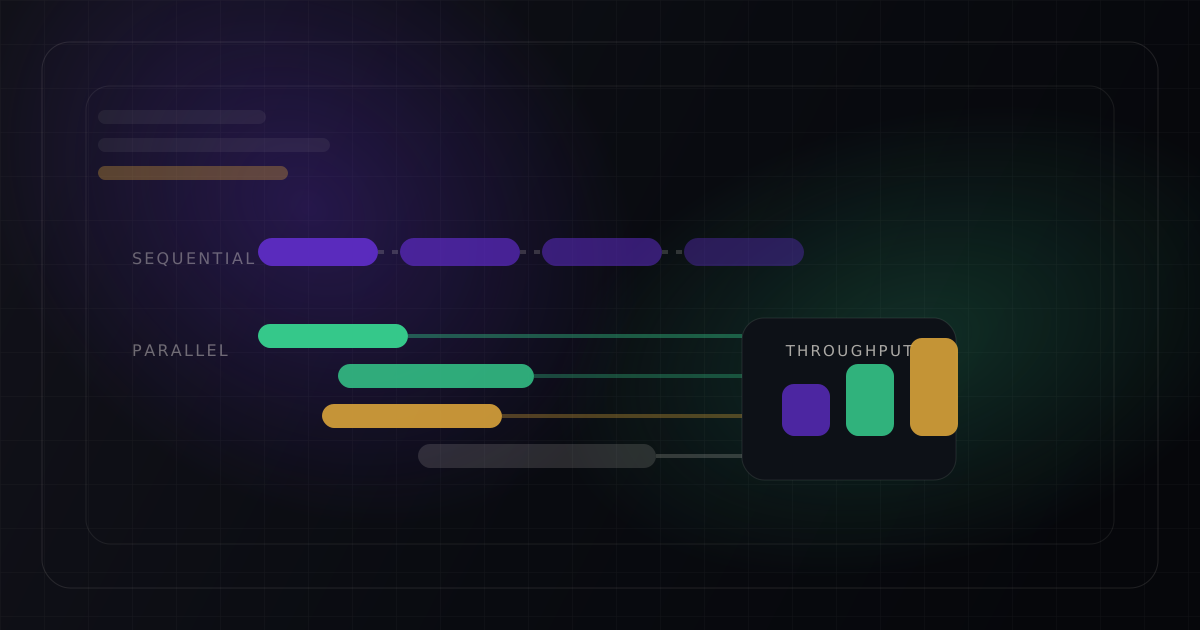
In software engineering, one of the most powerful optimizations you can make is parallelization — taking tasks that don't depend on each other and running them at the same time. It's the difference between a system that processes a million transactions in hours versus one that does it in seconds.
But here's the thing: this isn't just a technical concept. It's a mental model that applies to nearly every domain where time, throughput, and outcomes matter. Once you start seeing the world through the lens of parallelization, you can't unsee it.
The Sequential Trap
Most of us default to sequential thinking. We finish one thing, then start the next. We wait for a response before moving forward. We treat our goals like a checklist: item one, then item two, then item three.
How most people work
Each step waits for the previous one — idle time compounds
It feels orderly. It feels manageable. And sometimes it's necessary — genuine dependencies exist, and respecting them matters.
But more often than not, we impose artificial sequencing on work and life that could run concurrently. We wait when we don't need to. We idle when we could be progressing on something else.
We confuse "I can only focus on one thing" with "only one thing can be in motion." That distinction is everything.
Parallelization at Work
In engineering leadership, I've seen this pattern over and over: teams that ship fast aren't the ones with the most people or the biggest budgets. They're the ones that have learned to identify true dependencies and decouple everything else.
Sequential approach
- ×Wait for DB schema before starting API layer
- ×Wait for QA on Feature A before dev on Feature B
- ×Run integration tests after all components are done
Parallelized approach
- ✓Define the contract early, build both sides simultaneously
- ✓Pipeline the work — one team's output feeds the next with no idle time
- ✓Test continuously as each piece becomes ready
Sequential vs. parallel execution
Sequential — 16 weeks
Parallel — 8 weeks
The result isn't just speed — it's momentum. Teams that operate this way develop a rhythm. They build confidence that things are always moving forward, even when individual pieces hit friction.
Parallelization in Project Management
The best project managers I've worked with think like schedulers in an operating system. They look at a body of work and ask one question before anything else:
What actually depends on what?
The critical path — the longest chain of dependent tasks — determines your minimum delivery time. Everything else is a candidate for parallelization. And the difference between a team that ships in six weeks versus twelve often comes down to how well they exploit that.
Dependency map — finding the critical path
This is where a Mitigation of Delays Plan becomes powerful. You're not just reacting to problems — you're designing your execution to absorb them. When you run things in parallel, a delay in one stream doesn't necessarily delay the whole operation.
Parallelization in Decision-Making
Sequential decision-making is one of the biggest hidden bottlenecks in organizations.
Sequential decisions
- ×Ask one person, wait for answer
- ×Schedule a meeting to discuss
- ×Get partial answer, schedule follow-up
- ×Weeks pass before decision is made
Parallel decisions
- ✓Send the question to three people at once
- ✓Gather data from multiple sources simultaneously
- ✓Run small experiments in parallel
- ✓Compress the information-gathering phase
This doesn't mean being reckless. It means recognizing that the cost of waiting is often higher than the cost of running a few extra threads of inquiry.
You don't need all the data — you need sufficient data from enough independent sources to have conviction.
Parallelization in Communication
Think about how most people handle complex, multi-stakeholder communication. They write one message, send it to one person, wait for a response, then incorporate that into the next message to the next person.
Sequential vs. parallel communication
Sequential
Parallel
This requires more effort upfront — you need to think carefully about what information each person needs and structure the message so it serves multiple audiences. But that upfront investment pays for itself many times over in reduced back-and-forth and faster alignment.
Parallelization in Life
This is where it gets personal and still a lot of work to do on my behalf to get to where I want to be.
We're often told to focus on one thing at a time. And there's wisdom in that — deep work requires concentration, and context switching has real costs. But at the macro level, life doesn't have to be sequential.
Life threads — concurrent, not sequential
These aren't dependent tasks — they're concurrent threads that enrich each other
The person who exercises while building a company isn't distracted, they're running parallel processes that make each other better. The leader who invests in creative hobbies alongside their professional work isn't unfocused, they're developing cognitive diversity that feeds back into everything they do.
The key — just like in engineering — is understanding your actual dependencies and your real capacity. You need to know which threads are CPU-bound (requiring your direct, focused attention) and which are I/O-bound (waiting on external input where you can let them run in the background).
The Art of Identifying Dependencies
If parallelization is the strategy, dependency mapping is the skill. And it's a skill that most people underinvest in.
Dependency check — ask before every project
Before you start any project, any initiative, any significant life decision, ask yourself: what actually blocks what? You'll almost always find that the number of true dependencies is smaller than you assumed. Many of the sequences you've been following are habits, not requirements.
The Compound Effect
Here's the part that most people miss: parallelization doesn't just save time linearly. It compounds.
The compounding loop
The flywheel accelerates — gains compound over time
At a personal level, running multiple threads of growth in parallel means that the gains in one area reinforce the others. Physical health improves cognitive performance. Creative pursuits improve problem-solving at work. Strong relationships provide the emotional foundation for taking professional risks.
It's not about doing more for the sake of doing more. It's about recognizing that many of the things you care about can progress simultaneously — and that waiting to start one until another is "done" is often an artificial constraint you've imposed on yourself.
Ship Faster. Live Fuller. Parallelize.
The world rewards throughput. Not busy-ness — throughput. The meaningful movement of things from idea to reality, from problem to solution, from intention to action.
Parallelization is how you increase throughput without burning out. It's not about working harder or longer. It's about working smarter — identifying what doesn't need to wait, decoupling what can be decoupled, and keeping multiple threads of progress alive at all times.
Whether you're leading an engineering team, managing a complex project, making high-stakes decisions, or simply trying to build a life that reflects all of your ambitions — the question is always the same:
What am I running sequentially that could run in parallel?
Start there. The answer might surprise you.