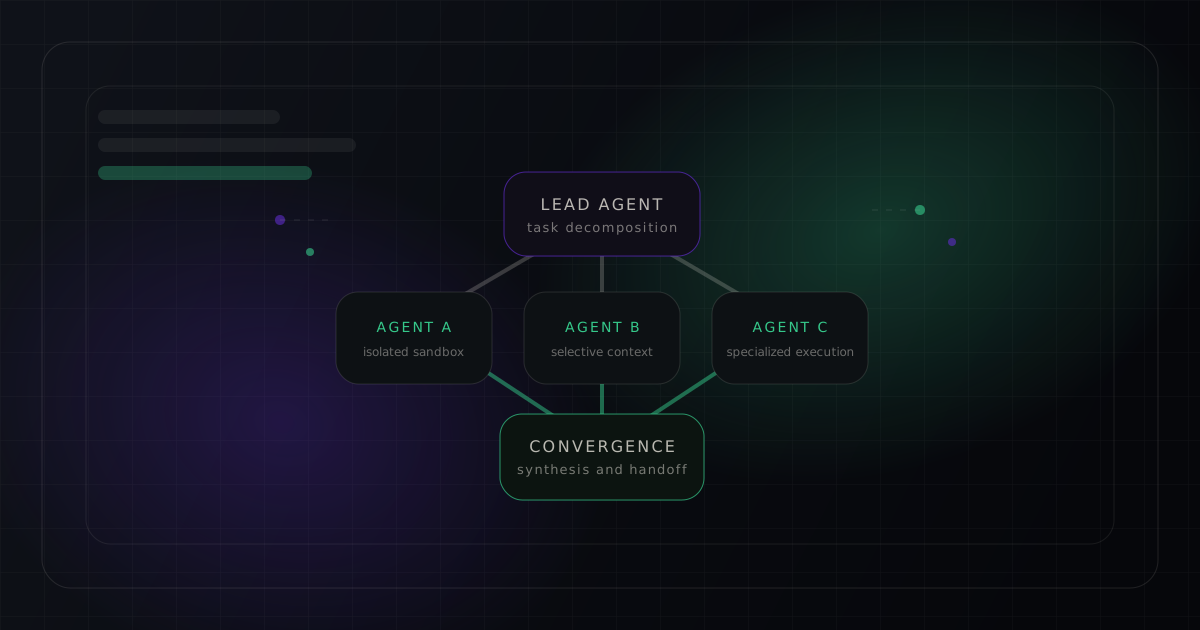
The Gap
Building one AI agent is a weekend project. Pick a model, define some tools, write a system prompt, deploy. The tutorials are everywhere. The frameworks are abundant. The demos are impressive. And then someone asks you to build a system where five agents collaborate on a research report, three of them running code in parallel, all sharing context efficiently, and converging on a coherent output — and you realize the weekend project was the easy part.
The gap between “I built an agent” and “I built a system of agents” is the same gap that separated scripting from distributed systems two decades ago. A single-threaded Python script is conceptually simple. A distributed system with message queues, consensus protocols, failure recovery, and observability is a fundamentally different engineering challenge. Multi-agent AI systems are going through the same transition right now, and most of the industry hasn't caught up.
The problems are eerily familiar. How do you decompose a complex task into subtasks that can be parallelized? How do you manage shared state without corruption? How do you handle partial failures gracefully? How do you debug a system where the behavior is emergent rather than prescribed? These are the same questions distributed systems engineers have been answering for decades — but the domain-specific answers for AI agents are still being written.
Over the past year at Midas Labs, we've built, broken, and rebuilt multi-agent systems for production workloads. We've tried the major frameworks, rolled our own orchestration layers, and studied open source systems like DeerFlow that apply these ideas to real workloads. What follows is a technical deep-dive into what we've learned: the core problems, the patterns that work, the patterns that don't, and an honest assessment of what's still broken.
Task Decomposition
The first problem in any multi-agent system is the same first problem in any parallel system: how do you break a single complex task into subtasks that can be executed concurrently? In the agent world, there are three dominant approaches, each with real trade-offs.
Static DAGs define the task graph upfront. You know in advance that Step A feeds into Step B, which feeds into Step C. The graph is fixed before execution begins. This is how most traditional workflow engines work, and it's how many agent frameworks implement multi-step tasks.
Static DAG
Static DAGs are predictable, testable, and easy to reason about. You can visualize the execution graph, estimate token costs in advance, and set up monitoring at each node. The downside is rigidity. If the task doesn't fit the predefined graph — if classification reveals the input needs a completely different processing pipeline — the DAG can't adapt. You end up building increasingly complex conditional branches to handle edge cases, and eventually the “static” DAG becomes a tangled mess of special cases.
Dynamic planning takes the opposite approach. The agent observes the current state, decides what to do next, executes, observes again, and repeats. There's no predefined graph. The model is the planner.
Dynamic Planning
Dynamic planning is maximally flexible. The agent can handle any input, pivot when unexpected results appear, and explore solution paths that weren't anticipated at design time. The downside is unpredictability. You can't estimate how many steps a task will take, how many tokens it will consume, or whether the agent will go down a rabbit hole that wastes resources without producing useful output. In production, unpredictability is a liability. You need to be able to set budgets, define SLAs, and guarantee termination.
Hierarchical decomposition is the middle ground that we've found works best for production systems. A lead agent receives the complex task and decomposes it into subtasks, each assigned to a specialized sub-agent. The lead agent plans statically, but sub-agents can plan dynamically within their scope. It's a DAG of planners, not a DAG of steps.
Hierarchical Decomposition
This approach gives you the predictability of static DAGs at the top level — you can estimate subtask count, set per-subtask budgets, and monitor progress — while preserving the flexibility of dynamic planning within each subtask. The lead agent provides structure; the sub-agents provide adaptability. It mirrors how effective human teams work: a project manager decomposes the work, specialists execute it, and the manager synthesizes the results.
Single-Level Planning
- ×One agent decides everything
- ×Context window fills with planning overhead
- ×Can't parallelize: each step waits for the last
- ×Single point of failure for the entire task
Hierarchical Decomposition
- ✓Lead agent plans, sub-agents execute
- ✓Each agent operates within focused context
- ✓Sub-tasks run in parallel where possible
- ✓Failures are isolated to individual sub-agents
Context Management
The context window is the fundamental constraint of every LLM-based system. It's finite, expensive, and shared across everything the model needs to know: system prompts, conversation history, tool definitions, intermediate results, and the actual input. In a multi-agent system, this constraint multiplies. Each agent has its own context window, and the lead agent needs to maintain context about the state of all sub-agents. Without careful management, context exhaustion is the default outcome.
The naive approach is context stuffing: load everything into the context window and let the model sort it out. This works surprisingly well for simple tasks with short contexts. It fails catastrophically for complex tasks. A 50-tool system prompt consumes 3,000 tokens before the user says anything. A conversation history that includes every intermediate result grows linearly with task complexity. By the time you're 50 interactions deep, the model is spending most of its attention on irrelevant context from early in the conversation, and the quality of its output degrades accordingly.
Context Stuffing
- ×Load all 50 tools in system prompt (3,000 tokens)
- ×Keep full conversation history (grows linearly)
- ×Every sub-task result stays in context
- ×Context window exhaustion after ~50 interactions
Context Engineering
- ✓Load 5 relevant tools per query (300 tokens)
- ✓Sliding window: keep last 10 exchanges + summaries
- ✓Sub-task results offloaded to filesystem
- ✓Sustained performance across 200+ interactions
Context engineering is the set of techniques that manage this constraint intentionally. The most effective strategies we've found are:
Progressive skill loading. Don't include all tools in every prompt. Maintain a registry of available tools and load only the ones relevant to the current sub-task. A research agent doesn't need access to code execution tools. A formatting agent doesn't need web search. Loading tools on demand reduces the baseline context cost from thousands of tokens to hundreds.
Aggressive summarization. When a sub-task completes, replace the full execution trace with a 2-3 sentence summary. The details are preserved in logs for debugging, but the context window only carries the outcome. This is the single most effective context management technique we've implemented — it typically reduces context growth by 80% with negligible information loss.
Filesystem offloading. Instead of keeping intermediate results in context, write them to the filesystem and reference them by path. The agent can read them back when needed, but they don't consume context when they're not actively being used. This is particularly effective for code generation tasks, where intermediate outputs can be thousands of tokens.
Context Budget Allocation
The best context management strategy isn't a bigger context window — it's a disciplined approach to what goes in the window you have.
Isolation & Safety
When agents execute code, they need sandboxes. This isn't a nice-to-have security feature — it's a fundamental architectural requirement for any system where multiple agents work concurrently. Without isolation, agents interfere with each other. Agent A installs a package that breaks Agent B's environment. Agent C modifies a file that Agent D is reading. The failure modes are non-deterministic, hard to reproduce, and devastating to debug.
Sandbox Model
Agent A
Isolated Filesystem
Own Workspace
Scoped Permissions
Agent B
Isolated Filesystem
Own Workspace
Scoped Permissions
Agent C
Isolated Filesystem
Own Workspace
Scoped Permissions
Each agent runs in its own Docker container — zero cross-session contamination
Docker containers are the most common isolation mechanism, and for good reason. Each agent gets its own filesystem, its own process space, and its own network namespace. The container can be spun up in seconds, pre-loaded with the tools and dependencies the agent needs, and torn down when the task completes. Cleanup is trivial: destroy the container and the state disappears.
But isolation goes beyond containers. Effective sandboxing also means scoped permissions — Agent A can read from the shared input directory but can only write to its own output directory. It means resource limits — no single agent can consume all available CPU or memory. And it means network isolation — agents can't make arbitrary outbound requests unless explicitly allowed. The principle is defense in depth: even if one layer fails, the others contain the blast radius.
The cost of isolation is overhead. Spinning up a Docker container takes time. Running five separate environments consumes more memory than running five threads in a single process. But for production multi-agent systems, this overhead is a feature, not a bug. The alternative — debugging non-deterministic failures caused by shared state corruption across agents — is vastly more expensive than the extra seconds of container startup.
Convergence
Sub-agents produce results. Those results need to become a single, coherent output. This is the convergence problem, and it's harder than it looks. When three agents independently research the same topic, they produce three perspectives that may overlap, contradict, or complement each other. The lead agent needs to synthesize these perspectives into something that reads like it was written by one author with one coherent viewpoint.
Convergence Pattern
The pattern that works is a multi-stage pipeline. First, a validation gate checks that each sub-agent actually completed its assigned task and produced output in the expected format. Malformed or incomplete outputs are flagged for retry or manual review. Second, a conflict resolution step identifies contradictions between sub-agent outputs and resolves them — either by selecting the most authoritative source, by synthesizing a balanced perspective, or by flagging the conflict for human review. Third, the synthesis step weaves the validated, de-conflicted outputs into a single coherent result.
The temptation is to skip the intermediate steps and just dump all sub-agent outputs into a single prompt: “Here are three research summaries. Combine them into one document.” This works for simple cases but fails when the stakes are high. Without validation, you get hallucinated citations smuggled through from a sub-agent that misunderstood its task. Without conflict resolution, you get paragraphs that contradict each other. The multi-stage approach costs more tokens but produces dramatically better results.
Case Study: DeerFlow
DeerFlow (bytedance/deer-flow) is best understood as a deep-research workflow built on LangGraph, not as a generic agent swarm toolkit. Its public architecture centers on a coordinator, a planner, a researcher, a coder, and a reporter. That narrower scope is a strength: it shows what orchestration looks like when you design around a concrete workload instead of abstract agent hype.
DeerFlow Architecture
Search + Crawl + MCP
Python Execution
Report Synthesis
Task decomposition in DeerFlow follows the shape we trust most: one planning layer, multiple specialist roles. The coordinator and planner interpret the request, decide whether more clarification is needed, and hand work to the researcher or coder depending on whether the task needs external information, code execution, or both.
Context management benefits from that role separation. The planner does not need every raw search result, and the reporter does not need every intermediate reasoning step. Structured handoffs between planner, researcher, coder, and reporter keep the workflow more disciplined than the all-context-to-all-agents pattern that causes most multi-agent systems to bloat.
Isolation in DeerFlow is more modest than the container-per-agent story people often tell. The public architecture is role-oriented: research stays with search and crawling tools, code execution stays with the coder, and the project offers Docker-based deployment for reproducible setup. Clear role boundaries are a practical form of isolation even when you are not spinning up a fresh sandbox for every subtask.
Convergence happens in the reporter stage. Research findings, code outputs, and tool results come back into one reporting flow that produces a final artifact for the console or web UI. That explicit reporting stage is the part many orchestration demos skip, and it's one reason DeerFlow is more useful as a reference architecture than a toy swarm.
What's elegant about DeerFlow is the separation of concerns. The lead agent doesn't know or care how sub-agents execute their tasks. Sub-agents don't know or care about the broader task context. The orchestration layer mediates everything, which means you can swap out sub-agents, change execution environments, or modify convergence strategies without touching the rest of the system.
What's pragmatic is the technology mix. DeerFlow uses LangGraph for workflow state, MCP for extensibility, Python for the orchestration engine, and a web UI for interaction. Proven parts, applied to a real workload.
What's still unsolved is visibility into the orchestration process. When a 5-agent task produces an unexpected result, it's hard to determine which agent went wrong, at what point, and why. The execution traces are available, but there's no equivalent of a distributed tracing system (like Jaeger or Zipkin) purpose-built for multi-agent workflows. This is the next frontier for the framework.
DeerFlow is most useful as a reference architecture: a concrete planner/researcher/coder/reporter pipeline, not a generic swarm fantasy.
Patterns That Work
After a year of building multi-agent systems, four patterns have proven consistently reliable across different domains, task complexities, and team sizes. These aren't theoretical recommendations — they're patterns we've validated in production and continue to use daily.
Principles
01 — Hierarchical > Flat
For complex tasks, a lead agent that decomposes and delegates beats a flat swarm every time. Flat architectures devolve into chaos. Hierarchies provide structure, accountability, and predictable resource consumption.
02 — Aggressive Context Pruning
Summarize completed sub-tasks ruthlessly. Offload intermediate results to the filesystem. Load tools on demand. A lean context window produces better results than a stuffed one, regardless of the model's maximum capacity.
03 — Sandboxed Execution
Every agent that executes code runs in its own container. No exceptions. The debugging cost of shared-state corruption in multi-agent systems dwarfs the overhead of container isolation. Treat this as non-negotiable infrastructure.
04 — Persistent Local Memory
Agents that remember what they've learned perform dramatically better over time. But memory must be local — stored on infrastructure you control, not in a third-party API. Memory is a competitive advantage; it shouldn't be a dependency.
What's Still Broken
Intellectual honesty requires acknowledging what doesn't work yet. Multi-agent systems in 2026 have four major gaps that no framework has fully addressed, including DeerFlow. These aren't minor inconveniences — they're fundamental challenges that limit the reliability and scalability of multi-agent architectures.
Debugging is brutal. When a 5-agent pipeline produces an incorrect result, determining which agent made the wrong decision is a manual, time-consuming process. You need to read through execution traces for each agent, correlate timestamps, identify where the reasoning went off track, and figure out whether the problem was in task decomposition, execution, or convergence. There's no equivalent of console.log for multi-agent reasoning. Distributed tracing tools like Jaeger exist for microservices, but nothing equivalent exists for agent orchestration. Someone will build it, but it doesn't exist yet.
Testing is expensive. Unit tests for agents are essentially useless. You can test that a tool call returns the right format, but you can't test that an agent will make the right decision in context — because the decision depends on the model, the context, and the specific phrasing of the prompt, all of which vary non-deterministically. Integration tests work but cost real money — each test run consumes actual tokens. We've settled on a strategy of deterministic tests for the orchestration layer and statistical tests for agent behavior, but it's unsatisfying. The feedback loop is slow and the confidence intervals are wide.
Observability is primitive. In a multi-agent system, the most important questions are: which agent consumed the most tokens? Where did the budget go? Which sub-task took the longest? Was the task decomposition efficient, or did the lead agent create redundant sub-tasks? Today, answering these questions requires manual analysis of logs. There's no dashboard, no alerting, and no automated optimization. For teams running multi-agent systems at scale, this is the most pressing gap.
Cost prediction is impossible. You can estimate the cost of a single agent interaction with reasonable accuracy. You cannot estimate the cost of a multi-agent task before running it. The number of sub-tasks depends on the input. The token consumption of each sub-task depends on what the agent discovers during execution. The number of convergence iterations depends on whether sub-agents produce conflicting results. The variance is too high for meaningful prediction, which makes budgeting and pricing extremely difficult for production services.
Where This Is Heading
Agent orchestration in 2026 looks like distributed systems did in 2010. The problems are real, the solutions are emerging, and the tooling is primitive but improving rapidly. Just as the distributed systems world eventually converged on standard patterns — service meshes, circuit breakers, distributed tracing, container orchestration — the agent world will converge on standard patterns for task decomposition, context management, isolation, and convergence.
The frameworks that will win are the ones that treat these patterns as first-class concerns, not afterthoughts. DeerFlow is one example of a project that gets meaningful pieces of this right. There will be others. The key insight is that multi-agent orchestration is an infrastructure problem, not an AI problem. The models are good enough. The orchestration isn't — yet.
If you're building multi-agent systems today, our advice is simple: invest in orchestration infrastructure before you invest in smarter agents. A well-orchestrated system of capable agents will outperform a poorly orchestrated system of brilliant ones every time. The bottleneck isn't intelligence. It's coordination.
The hard part isn't building agents.
It's making them work together.
We're in the distributed systems era of AI. The patterns are emerging.